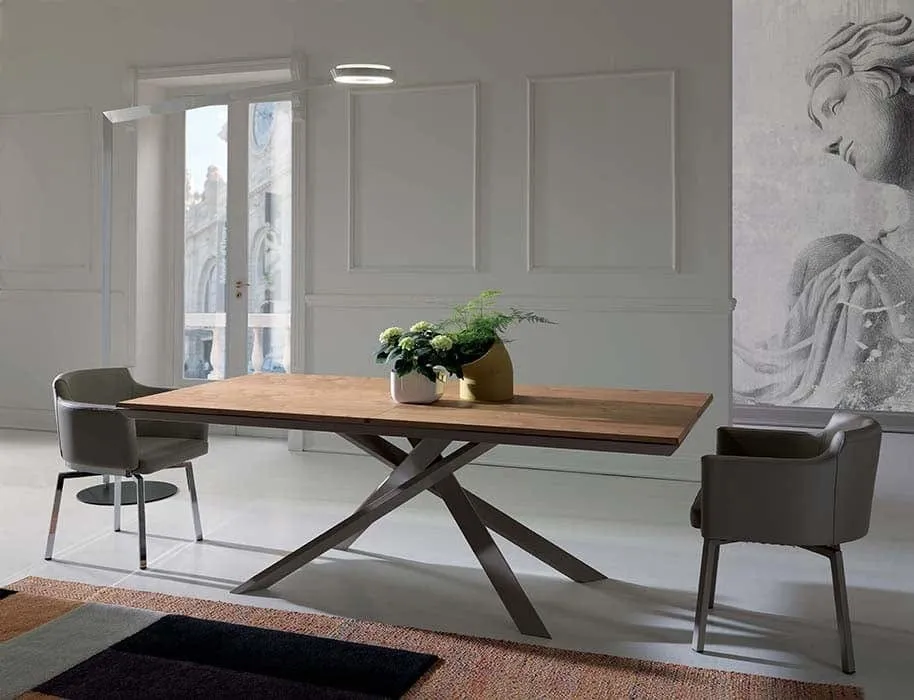
An extendable dining table mechanism allows a table to expand and contract, offering flexibility for different seating needs.
It’s a space-saving solution, perfect for small homes or hosting extra guests without needing a permanently large table.
These tables use various mechanisms like center leaf extensions, butterfly leaves, and telescopic systems to adjust their size.

Some designs allow self-storage of leaves, while others require separate storage for the extra sections.
Whether you prefer a manual or automatic system, extendable tables make dining more versatile and convenient.
In this guide, we’ll explore different mechanisms, their benefits, and how to choose the right one for your home.
How Extendable Dining Table Mechanisms Work

Extendable dining tables are designed with a sturdy base and extension leaves that allow them to adjust in size.
The main table structure remains fixed, while additional leaves or panels can be inserted, flipped, or slid into place when extra seating is needed.
Types of Sliding and Extension Systems
Different mechanisms make these extensions possible.
Some tables use center extension leaves, where the tabletop pulls apart to make space for an insert.
Others feature end extensions, where extra panels attach to the table ends.
More advanced systems, like butterfly leaves, fold and store inside the table, while telescopic extensions smoothly expand with a guiding track.
Manual vs. Automatic Extension Systems
Some tables rely on a manual mechanism, requiring you to physically pull, lift, or slide the extension into place.
These are affordable and durable but require more effort.
Automatic mechanisms, on the other hand, use geared slides or motorized systems to extend the table with minimal effort, offering a seamless and modern solution.
Types of Extendable Dining Table Mechanisms
Extendable dining tables come in various mechanisms, each offering unique benefits.
Whether you’re looking for extra seating for special occasions or a compact design for daily use, choosing the right mechanism can make all the difference.
Let’s explore the most common types and their pros and cons.
1. Center Leaf Extension

This classic mechanism features removable leaves inserted in the middle of the table.
The tabletop splits apart, creating space for one or more leaves.
Pros: Expands significantly, allowing multiple leaves for maximum extension.
Cons: Some leaves require separate storage, which takes up space.
2. End Leaf Extension (Company Boards)

Extra leaves attach to the ends of the table instead of the center.
This method keeps the main tabletop intact while extending only the edges.
Pros: The table frame remains stable, and leaves are easy to attach.
Cons: Cannot be self-stored, and expansion is limited due to lack of center support.
3. Butterfly Leaf Extension

This design features a hidden folding leaf stored under the table, which expands when needed.
The leaf unfolds in a butterfly motion, making it a space-saving choice.
Pros: Self-storing, easy to operate, ideal for compact spaces.
Cons: More visible seams on the tabletop and a slightly more complex mechanism.
4. Drop Leaf Extension

Drop leaf tables have hinged leaves on the sides that can be folded up or down.
When extended, they create a larger surface.
Pros: Compact design, great for small apartments or kitchens.
Cons: Limited expansion, not ideal for large gatherings.
5. Sliding Extension Mechanism

The tabletop slides apart, revealing hidden extension leaves underneath.
Some models require manually placing the leaves, while others have a built-in sliding system.
Pros: Smooth operation, supports multiple expansions with ease.
Cons: Some models require manual lifting of the extension leaves.
6. Telescopic Extension System

This modern mechanism uses a lever-based system to expand the table in a single, smooth movement.
The leaves slide out automatically along guiding tracks.
Pros: Effortless expansion, sleek and modern design.
Cons: More expensive due to complex engineering.
7. Folding Extension (“Book” System)

In this mechanism, the tabletop slides sideways and then folds open like a book, instantly doubling its size.
Pros: No need for separate leaves, expands instantly.
Cons: No option for partial extension, as it fully doubles in size.
Types of Sliding Mechanisms for Extendable Tables
The sliding mechanism plays a crucial role in how smoothly your extendable dining table expands and contracts.
Choosing the right one ensures durability, ease of use, and long-term performance.
Here are the two most common sliding mechanisms:
1. Wooden Slides

Wooden slides are the traditional choice for solid wood dining tables.
They feature interlocking wooden rails that allow the table to expand when pulled apart.
Pros: Extremely strong and durable, ideal for heavy solid wood tables.
Cons: Requires manual effort to extend, may stick over time if not properly maintained.
2. Geared Metal Slides

Geared metal slides use a precision-engineered system to ensure smooth and even movement.
This mechanism ensures that both sides of the table extend equally, reducing strain on the table frame.
Pros: Offers effortless and balanced movement, ideal for larger tables.
Cons: More moving parts means occasional maintenance is needed to prevent wear and tear.
Features That Improve Extendable Table Stability

A well-designed extendable dining table should not only expand easily but also stay stable and secure when in use.
Several key features contribute to maintaining balance, preventing wobbling, and ensuring long-term durability.
1. Locking Mechanisms
Locking mechanisms secure the table in place after it has been extended, preventing any shifting or unwanted movement.
These locks can be manual latches or automatic clips, depending on the table’s design.
Why It Matters: Keeps the table stable, so there’s no risk of it closing unexpectedly.
2. Table Runners & Guides
Table runners and guides are built-in tracks or channels that help the extension leaves slide smoothly and evenly into place.
These components ensure that alignment stays perfect when the table is expanded.
Why It Matters: Prevents misalignment, ensuring that the table looks seamless when extended.
3. Extra Legs & Support Braces
For larger extendable tables, extra legs or hidden support braces are often added to prevent sagging.
These supports deploy when the table extends, keeping the structure strong even at maximum length.
Why It Matters: Provides additional stability for long tables, making sure they can handle extra weight without bending.
By choosing an extendable dining table with these stability features, you’ll enjoy a sturdy and reliable table that stays secure, whether it’s compact or fully extended.
Choosing the Right Extendable Dining Table

An extendable dining table is a great investment, but choosing the right one requires careful consideration of several factors.
From size and material to ease of use, the right table should fit seamlessly into your home and lifestyle.
1. Size & Seating Capacity
Before picking a table, measure your dining space to ensure it fits both when compact and fully extended.
Consider how many people you regularly host—some tables expand for two extra guests, while others can accommodate large gatherings.
Tip: Leave at least 36 inches around the table for chairs and movement.
2. Material & Design
Extendable tables come in wood, glass, metal, and mixed materials, each offering a unique look.
Solid wood adds warmth and durability, glass creates a modern feel, and metal frames provide an industrial touch.
Choose a style that blends with your home décor.
Tip: If you want a timeless look, go for natural wood like oak or walnut.
3. Ease of Use
Some extension mechanisms are effortless, while others require manual effort.
If you frequently extend your table, look for a system that operates smoothly, such as a butterfly leaf or telescopic extension.
Tip: Test the mechanism before buying to ensure it works easily.
4. Manual vs. Automatic Systems
Manual tables require you to physically insert leaves or slide extensions, while automatic systems use gears or levers to expand with minimal effort.
Automatic options are more expensive but highly convenient, especially for frequent use.
Tip: If convenience is a priority, a telescopic or motorized system might be worth the investment.
By considering these factors, you’ll find an extendable dining table that fits your space, matches your style, and offers the functionality you need for everyday meals and special occasions.







 English
  Italian
  French
  German
  Spanish
  Portuguese
  Japanese
  Korean
  Russian
  Arabic
  Thai
Thai  Chinese